Domesday Book (/ˈduːmzdeɪ/ or US /ˈdoʊmzdeɪ/;[1][2] Latin: Liber de Wintonia "Book of Winchester") is a manuscript record of the "Great Survey" of much of England and parts of Wales completed in 1086 by order of King William the Conqueror. TheAnglo-Saxon Chronicle states:
It was written in Medieval Latin, was highly abbreviated, and included some vernacular native terms without Latin equivalents.[3]The survey's main purpose was to determine what taxes had been owed during the reign of King Edward the Confessor. (This interpretation is challenged by some historians, who see it as an attempt to assess where power lay after a wholesale redistribution of land after the conquest.)
The assessors' reckoning of a man's holdings and their values, as recorded in Domesday Book, was dispositive and without appeal. The name Domesday Book (Middle English for Doomsday Book) came into use in 12th century.[4] As Richard FitzNealwrote circa 1179 in the Dialogus de Scaccario:[5]
The manuscript is held at The National Archives at Kew, London. In 2011 the Open Domesday site made the manuscript available online.[6]
The book is an invaluable primary source for modern historians and historical economists. No survey approaching the scope and extent of Domesday Book was attempted again in Britain until the 1873 Return of Owners of Land (sometimes termed the "Modern Domesday")[7] which presented the first complete, post-Domesday picture of the distribution of landed property in the British Isles.[8]
Contents
[hide]- 1Content and organization
- 2Name
- 3Survey
- 4Purpose
- 5Subsequent history
- 5.1Custodial history
- 5.2Binding
- 5.3Publication
- 6Importance
- 7See also
- 8Notes
- 9References
- 10Further reading
- 11External links
Content and organization
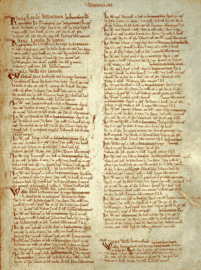

Domesday Book encompasses two independent works: "Little Domesday" (covering Norfolk, Suffolk, and Essex) and "Great Domesday" (covering much of the remainder of England and parts of Wales—
Little Domesday was named for being in a physically smaller format than its companion, but this survey is the more detailed, down to numbers of livestock. It may have represented the first attempt, resulting in a decision to avoid such level of detail in Great Domesday.
Both volumes are organized into a series of chapters (literally "headings", from Latin caput, "a head") listing the fees (knight's fees or fiefs, broadly identical to manors), held by a named tenant-in-chief of the king (who formed the highest stratum of Norman feudal society below the king), namely religious institutions, Bishops, Norman warrior magnates and a few Saxon thegns who had made peace with the Norman regime. Some of the largest such magnates held several hundred fees, in a few cases in more than one county. For example, the chapter of the Domesday Book Devonshire section concerning Baldwin the Sheriff lists 176 holdings held in-chief by him. Only a few of the holdings of the large magnates were held in demesne, most having been subinfeudated to knights, generally military followers of the tenant-in-chief (often his feudal tenants from Normandy) which latter thus became their overlord. The fees listed within the chapter concerning a particular tenant-in-chief were usually ordered, but not in a systematic or rigorous fashion, by the Hundred Court under the jurisdiction of which they were situated, not by geographic location.
As a review of taxes owed, it was highly unpopular.

Each county's list opened with the king's demesne lands (which had possibly been the subject of separate inquiry). It should be borne in mind that under the feudal system the king was the only true "owner" of land in England, under his allodial title. He was thus the ultimate overlord and even the greatest magnate could do no more than "hold" land from him as a tenant (from the Latin verb teneo, "to hold") under one of the various contracts of feudal land tenure. Holdings of Bishops followed, then of the abbeys and religious houses, then of lay tenants-in-chief and lastly the king's serjeants (servientes), and Saxon thegns who had survived the Conquest, all in hierarchical order.
In some counties, one or more principal towns formed the subject of a separate section: in some the clamores (disputed titles to land) were also treated separately. This principle applies more specially to the larger volume: in the smaller one, the system is more confused, the execution less perfect.
Domesday names a total of 13,418 places. Apart from the wholly rural portions, which constitute its bulk, Domesday contains entries of interest concerning most of the towns, which were probably made because of their bearing on the fiscal rights of the crown therein. These include fragments of custumals (older customary agreements), records of the military service due, of markets, mints, and so forth. From the towns, from the counties as wholes, and from many of its ancient lordships, the crown was entitled to archaic dues in kind, such as honey. (In a parallel development, around 1100 the Normans in southern Italy completed their Catalogus Baronum based on Domesday Book.)
Name
The manuscripts do not carry a formal title. The work is referred to internally as a descriptio (survey), and in other early administrative contexts as the king's brevia (writings). From about 1100, references appear to the liber (book) or carta (document) of Winchester, its usual place of custody; and from the mid-12th to early 13th centuries, to the Winchester or king's rotulus (roll).
To the English, however, who held the book in awe, it became known as "Domesday Book", in allusion to the Last Judgement, and in specific reference to the definitive character of the record.[13] The word "doom" was the usual Old English term for a law or judgement; it did not carry the modern overtones of fatality or disaster.[14] Richard FitzNeal, treasurer of England under Henry II, explained the name's connotations in detail in the Dialogus de Scaccario (c.1179):
The name "Domesday" was subsequently adopted by the book's custodians, being first found in an official document in 1221.
Either through false etymology or deliberate word play, the name also came to be associated with the Latin phrase Domus Dei ("House of God"). Such a reference is found as early as the late 13th century, in the writings of Adam of Damerham; and in the 16th and 17th centuries, antiquaries such as John Stow and Sir Richard Baker believed that this was the name's origin, alluding to the church in Winchester in which the book had been kept. As a result, the alternative spelling "Domesdei" became popular for a while.
The usual modern scholarly convention is to refer to the work as "Domesday Book" (or simply as "Domesday"), without a definite article. However, the form "the Domesday Book" is also found in both academic and non-academic contexts.
Survey
The Anglo-Saxon Chronicle states that planning for the survey was conducted in 1085, and the colophon of the book states the survey was completed in 1086. It is not known when exactly Domesday Book was compiled, but the entire copy of Great Domesday appears to have been copied out by one person on parchment (prepared sheepskin), although six scribes seem to have been used for Little Domesday. Writing in 2000, David Roffe argued that the inquest (survey) and the construction of the book were two distinct exercises. He believes that the latter was completed, if not started, by William II following his assumption of the English throne; he quashed a rebellion that followed and was based on, though not consequent on, the findings of the inquest.
Most shires were visited by a group of royal officers (legati), who held a public inquiry, probably in the great assembly known as the shire court. These were attended by representatives of every township as well as of the local lords. The unit of inquiry was the Hundred (a subdivision of the county, which then was an administrative entity). The return for each Hundred was sworn to by twelve local jurors, half of them English and half of them Norman.
What is believed to be a full transcript of these original returns is preserved for several of the Cambridgeshire Hundreds and is of great illustrative importance. The Inquisitio Eliensis is a record of the lands of Ely Abbey. The Exon Domesday (named because the volume was held at Exeter) covers Cornwall, Devon, Dorset, Somerset, and one manor of Wiltshire. Parts of Devon, Dorset and Somerset are also missing. Otherwise this contains the full details supplied by the original returns.
Through comparison of what details are recorded in which counties, six Great Domesday "circuits" can be determined (plus a seventh circuit for the Little Domesday shires).
- Berkshire, Hampshire, Kent, Surrey, Sussex
- Cornwall, Devon, Dorset, Somerset, Wiltshire (Exeter Domesday)
- Bedfordshire, Buckinghamshire, Cambridgeshire, Hertfordshire, Middlesex
- Leicestershire, Northamptonshire, Oxfordshire, Staffordshire, Warwickshire
- Cheshire, Gloucestershire, Herefordshire, Shropshire, Worcestershire — the Marches
- Derbyshire, Huntingdonshire, Lincolnshire, Nottinghamshire, Yorkshire

No comments:
Post a Comment