Thursday, 5 May 2016

55 B.C.E August 26 Julius Caesar lands

Having subdued Gaul, or so it seemed at the time, Julius Caesar launched an expedition to Britain. It was late in the campaigning season and it is doubtful if he was bent on conquest, more likely a reconnaissance in strength. He would certainly have hoped to increase his prestige at home and he might have wanted to postpone a recall to Rome, where his enemies could get at him. He was probably encouraged by some British chiefs, hoping to use the Romans as allies against rival tribes. Whatever Caesar’s intentions, he was defeated by the British weather.
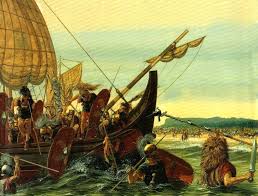
Image result for 55 B.C.E August 26 Julius Caesar lands
A Gaulish chieftain named Commius was sent across the Channel to enlist support for the Romans among the British tribes, while a trusted officer took a fast galley to reconnoitre the coast. Caesar assembled eighty ships at Boulogne to carry two legions, the Seventh and the Tenth, plus irregulars, altogether some 12,000 men. The cavalry and their horses were to sail separately from Ambleteuse, a few miles north. After waiting for a wind the Roman ships left Boulogne in the early hours of August 26th and came in sight of the white cliffs of Dover around 9am. The cliffs were bristling with menacing British warriors, horsemen and war chariots. It was obviously no place to land, but Caesar waited for hours offshore for the cavalry, which had got penned in Ambleteuse by tide and wind. In the afternoon the Roman fleet sailed north-east without them to pass the South Foreland and come in sight of the long stretch of flat shore to the north. The Britons moved along on land to keep pace.
Image result for 55 B.C.E August 26 Julius Caesar lands
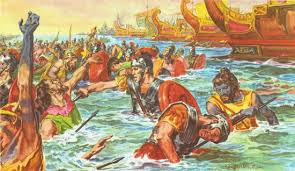
The Roman ships drew in and anchored offshore, probably about where Deal is now, and the legionaries were faced with wading to land, burdened with weapons and gear, while the Britons threw javelins at them and galloped menacingly to and fro on the beach. It was not an agreeable prospect and the soldiers hung back until the eagle-bearer of the Tenth jumped into the sea and shouted to his comrades to follow him and defend the standard. This they did and more and more of the Romans struggled through the waves to the beach. After savage fighting, the legionaries managed to form up, charge the Britons and drive them in flight. With no cavalry this could not be followed up and the Romans made camp. 
Image result for 55 B.C.E August 26 Julius Caesar lands
The Britons sent emissaries to Caesar to sue for peace, along with Commius with his tail between his legs. Caesar took hostages from them and after four days, on the 30th, the cavalry transports at last appeared, but were blown away by a sudden fierce storm and forced back to Gaul. The gale coincided with an exceptionally high tide and many of Caesar’s ships dragged their anchors and were wrecked on the beach. The Britons took note and started to muster their forces again. The Romans began repairing the ships, but now they were short of food. Parties ventured into the countryside to reap corn and gather supplies, but legionaries of the Seventh were ambushed by British chariots and horsemen. Fortunately for the Romans, the attack raised such a cloud of dust that Caesar saw it from the camp and hurried up with reinforcements. After several days of incessant rain Caesar managed to bring the British to a pitched battle, which was what Roman commanders always wanted against a barbarian and comparatively undisciplined enemy. The British were defeated with heavy casualties, but again could not be effectively pursued. Caesar had had enough. He embarked his men on the ships and sailed back to Gaul.
Image result for 55 B.C.E August 26 Julius Caesar lands
Caesar tried again the following year, launching a stronger and better prepared force of five legions on a second expedition, which carried him across the Thames at Brentford, but again the weather was abominable and gales played havoc with his ships and supplies. After concluding a face-saving treaty with the local British king he returned to Gaul once more. It was almost another hundred years before the Romans actually conquered Britain, in AD 43.

43 Roman occupation begins

With the Roman Conquest in 43 AD came the first written records of England's history. Julius Caesar had of course paid earlier visits to Britain in 55 and 54 BC however these had only been to please his adoring public back home in Rome (political propaganda!) In 43 AD the Emperor Claudius resumed the work of Caesar by ordering the invasion of Britain under the command of Aulus Plautius.
The Romans quickly established control over the tribes of present day southeastern England. One British chieftain of the Catuvallauni tribe known as Caractacus, who initially fled from Camulodunum (Colchester) to present day south Wales, stirred up some resistance until his defeat and capture in 51 AD. Dispatched off to Rome, he obviously made friends in high places, appearing in Claudius' triumphal procession. He was later released in recognition of his courage and died in Rome. Resistance to Roman rule continued in what is now Wales, particularly inspired by the Druids, the priests of the native Celtic peoples.
All was relatively quiet in Britannia for ten years or so until Prasutagus the king of the Iceni tribe, died. His queen, Boudica, a little upset at having her lands taken from her by the Romans and her two daughters raped, opted for affirmative action rather than the diplomatic approach. Under Boudica's leadership the Iceni together with their southern neighbours the Trinovantes revolted, burning to the ground Londinium (London), Verulamium (St. Albans) and Camulodunum (Colchester).Boudica poisoned herself after her army was virtually annihilated by Roman legions returning from active service in North Wales. They had again been attempting to quell the Druids in Anglesey.
Roman soldiers marching
During the 70's and 80's the Romans, under the command of Gnaeus Julius Agricola extended their control into northern and western England. Legions were located at YorkChester and Caerleon marking the limits of the 'Civil Zone'. Agricola moved northwards defeating the Caledonian tribes under the leadership of Calgacus at the battle of Mons Graupius in present day northeastern Scotland. The Romans gradually gave up their conquests in Scotland until in 122 AD the emperor Hadrian ordered the construction of a wall from the west coast of Britain to the east.
Hadrian's Wall ran for eighty miles from Newcastle in the east to Carlisle in the west. Designed to mark the boundaries of the Roman Empire, much of the great monument can still be seen today. When Hadrian died in 138 AD his successor Antonius Pius abandoned the newly completed wall and again pushed northwards. A new frontier, the Antonine Wall was established between the Forth and Clyde rivers in Scotland. Around 160 AD the Antonine Wall was abandoned and thereafter Hadrian's Wall again became the northern boundary of the Roman Empire in Britain.
©VisitBritain
The Romans never did succeed in subduing all of Britain. They always had to maintain a significant military presence to control the threat from the unconquered tribes. But most people in southern Britain settled down to Roman order and discipline. Towns appeared for the first time across the country, including York, Chester, St. Albans, BathLincoln, Gloucester and Colchester. All of these major centres are still linked today by the system of Roman military roads radiating from the great port of London such as Ermine Street, Watling Street and the Fosse Way. These roads also allowed for the distribution of Roman luxuries such as spices, wines, glass etc. brought in from other regions of the Empire. It is likely that the Romanisation of Britain principally affected only the rich. This aristocracy may have increased status by adopting Roman ways and practices such as regular bathing. The vast majority of the populace would remain relatively untouched by Roman civilisation, living off the land and eking out a living.

597 December Augustine carries out mass baptism

When Pope Gregory began to plan for the evangelization of England, the land was still largely pagan, although in the southwest there were remnants of earlier missionary efforts. To lead this important mission, Gregory chose Augustine, prior of St. Andrew's monastery in Rome, of which Gregory had been the founder. Nothing is known of Augustine's life until the year 596, when, with a party of Benedictine monks, he set out northwards from Rome. He carried letters of commendation to various Gallic bishops. On reaching Provence, the monks accompanying Augustine grew fearful of the dangers that lay ahead. Alarming stories were told of the ferocity of the pagans and the hazards of the Channel crossing. 
Image result for 597 December Augustine carries out mass baptism

They persuaded Augustine to return to Rome to ask the Pope's permission to abandon the whole enterprise. Meanwhile the Pope had received word that the common people of England and also some of their chieftains and kings were ready to welcome Christian missionaries. After Pope Gregory had told Augustine this news and had discussed the situation with him further, Augustine rejoined his companions and inspired them with his own courage. Taking with them several Franks to act as interpreters, the party crossed safely over to the Isle of Thanet, in the domain of Ethelbert, King of Kent, whom they formally notified of their arrival and of their purpose in coming.

Ethelbert was still a pagan, but his wife Bertha, daughter of King Charibert of the Franks, had been converted to Christianity. Sitting under a spreading oak, Ethelbert received the missionaries. After listening carefully to their words, he gave them permission to preach to his subjects. He also made over to them a house in Canterbury, with the use of the little stone church of St. Martin, which had stood there since the period of Roman occupation. This had formerly been the oratory of Queen Bertha and her confessor Liud hard. Ethelbert was converted and baptized at Pentecost, 597. After this promising start, Augustine went back to Provence to be consecrated bishop by Vergilius, metropolitan of Arles and papal legate for Gaul. On his return some ten thousand of Ethelbert's subjects were baptized in the Swale River.
Image result for 597 December Augustine carries out mass baptism

Augustine, greatly heartened by the success of his mission, now sent two of his monks to Rome to report to the Pope, and to ask for more helpers. Also he wished to have the Pope's counsel on various problems. When the monks came back to England with a fresh band of missionaries, they brought the pallium for Augustine. Among the new group were Mellitus, Justus, and Paulinus, who was afterwards archbishop of York. With these "ministers of the Word," wrote the Venerable Bede, "the holy Pope sent all things needed in general for divine worship and the service of the Church, viz. sacred vessels, altar cloths, ornaments for churches, and vestments for priests and clerks, and also many books." The latter item was especially important, for the books helped to inspire the great love of learning which characterized the English Church.

Gregory sent to Augustine a plan for developing an ecclesiastical hierarchy and establishing a working organization for the whole country-a plan which was not fully carried out in Augustine's lifetime. There was to be a northern and a southern province, with twelve suffragan bishops in each. In a letter to Mellitus, which is presented earlier, following the life of <St. Gregory>, he gave instruction on other points, showing his administrative ability as well as considerable psychological insight. Pagan temples were, as far as possible, to be Christianized and retained. Consecration rites and feasts of martyrs were to replace the heathen festivals, for, Gregory wisely writes, "he who would climb to a lofty height must go by steps, not leaps."

Image result for 597 December Augustine carries out mass baptism

In 603 Augustine rebuilt and reconsecrated the Canterbury church and the house given him by King Ethelbert. These structures formed the nucleus for his metropolitan cathedral. They were destroyed by fire in 1067, and the present cathedral, begun by the great Lanfranc in 1070, stands on their site. A converted temple outside the walls of Canterbury was made into another religious house, which Augustine dedicated to St. Peter and St. Paul. After his death this abbey became known as St. Augustine's.

With the King's support, the Christianization of Kent proceeded rapidly, but Gregory's charge had stated, "All the bishops of Britain we commend to your Fraternity." The survivors of the ancient British or Celtic Church and their bishops had been driven westward and southward into Wales and Cornwall by the Saxon conquerors of the fifth century. Here they had persisted as Christian communities, cut off from the outside world. Although they were sound in fundamental doctrine, some of their usages were at variance with those of Rome. Now, in virtue of his archiepiscopal jurisdiction, Augustine invited the Celtic bishops to meet with him at a spot outside the confines of Wessex, which has since come to be known as Augustine's Oak. In long conferences with the representatives of the Celtic Church Augustine urged them to comply with the customs of the rest of Western Christendom, in particular in the method of determining the date of Easter, and to aid him in converting the pagans. Loyalty to their own local traditions, however, and bitterness against their Saxon conquerors, made them unwilling to agree, even though Augustine performed a miracle of healing in their presence to prove the supernatural source of his authority. 

Image result for 597 December Augustine carries out mass baptism
They consented to attend a second conference, held in Flintshire, but it too proved a failure. Augustine did not rise to greet his Celtic brothers when they arrived and they felt that he lacked Christian humility. They refused either to listen to him or acknowledge him as their archbishop. It was not until 664, at the Synod of Whitby, that their differences were resolved and ecclesiastical uniformity was established.

Augustine's last years were spent in spreading and consolidating the faith in Ethelbert's realm, which comprised large sections of eastern England south of Northumbria. Sees were established in London and Rochester, with Mellitus appointed bishop over one and Justus over the other. Seven years after his arrival Augustine died, leaving the continuation of his work to others.

664 synod of Whitby

Synod of Whitbya meeting held by the Christian Church of the Anglo-Saxon kingdom of Northumbria in 663/664 to decide whether to follow Celtic or Roman usages. It marked a vital turning point in the development of the church in England.
Whitby Abbey [Credit: Neil Gray]
Though Northumbria had been mainly converted by Celtic missionaries, there was by 662 a Roman party, which included Queen Eanfled, Bishop Wilfrid, and other influential people. The Celtic party was led by the bishops Colman and Cedd and Abbess Hilda. Two accounts of the synodsurvive, in Bede’s Ecclesiastical History of the English People and in the life of Wilfrid by the monk Eddi. King Oswiu decided in favour of Rome because he believed that Rome followed the teaching of St. Peter, the holder of the keys of heaven. The decision led to the acceptance of Roman usage elsewhere in England and brought the English Church into close contact with the Continent.

793 June 8 monastery at Lindisfarne destroyed in Viking raid

The Vikings

Viking helmet.The much repeated Anglo-Saxon prayer " From the fury of the northmen O Lord deliver us" evokes the terror a Viking landing inspired in the Anglo-Saxon population. The Anglo-Saxon Chronicle ruefully records fearful omens in the year 793, lightning, high winds, flying dragons, famine, "and a little after that, in the same year, on 8 June, the ravages of the heathen men miserably destroyed God's church on Lindisfarne with plunder and slaughter."

By 820, the Irish Annals of Ulster tell of similar terrifying occurrences for the year 820: "The sea spewed forth floods of foreigners over Erin, so that no haven, no landing-place, no stronghold, no fort, no castle might be found, but it was submerged by waves of Vikings and pirates."

Norse warriors from Denmark, Norway and Sweden, they were skilled sailors with advanced methods of shipbuilding. The Vikings (from the Old Norse víkingr) terrorised and later settled large areas of Europe from the late 8th to the 11th century. In their longships, or dragon prows, they travelled as far east as Constantinople and the Volga River in Russia. In around 980, Erik the Red founded a settlement on Greenland. Viking legend relates that Erik the Red's son, Leif Eriksson, succeeded in reaching the North American continent, calling his settlement Vinland, or the "land of the grapes." Viking weapons and tools have been uncovered in Newfoundland, Canada.

Viking attacks on England

The Anglo-Saxon Chronicle records that Norwegian Vikings sailed into Portland Bay, Dorset in 787. A royal official mistook them for merchants and was killed whilst attempting to request that they to accompany him to the king's manor to pay a trading tax on the goods they were bringing into England.

Further raids followed, on 8th June 8, 793, the monastery on the island of Lindisfarne was attacked, its occupants murdered and the gold, jewellery and relics taken. Monasteries were a favoured target due to the riches which were contained in them. Jarrow was invaded in 794 and Iona in 795, 802 and 806. After repeated raids by the Norsemen, the monks of Lindisfarne fled the monastery in AD 875, taking the venerated relics of Saint Cuthbert with them for safekeeping.

In 835 a fleet of Viking longboats sailed up the Thames estuary and ravaged the Isle of Sheppey. In 850 a further army, failing to follow the usual pattern of returning home over winter, encamped on the Isle of Thanet in the Thames estuary. The Kentish people offered payment known as Danegeld to hold off the ferocious attacks.

The Viking chief Ragnar Lodbrok, a legendary Norse hero, was captured by Aella of Northumbria and thrown alive into a pit of adders. It is said that when the four sons of Ragnar heard news of how their father had met his death, Hvitserk, who was playing chess gripped the piece so hard that blood issued from his finger nails. Bjorn gripped his spear so tightly that he left an impression in it and Sigurd who was trimming his nails cut straight through to the bone. Ragnar's eldest son, known as Ivar the Boneless, was bent on vengeance, and later met Aella in battle, capturing him and sentenced him to a painful death in accordance with the custom of Rista Blodorn (Blood eagle) which entailed cutting the ribs of the victim out and removing the lungs, spreading them over the body.

A large army of Danish Vikings landed on English shores in 865, led by Ivar, Halfdan and Guthrum. Landing in East Anglia, they marched into Northumbria, capturing York, known to them as Jorvik, which was to become an area of large Viking settlement. They were valiantly opposed by the Saxon king Alfred of Wessex and his successors of the House of Wessex.

At first depressing series of defeats at the hands of the Vikings continued unabated and Alfred was forced into a strategy of buying them off. As a result they ceased their attacks and for a period of five years, peace reigned in Wessex. This peace was not likely to last for any considerable length of time and was at best a temporary measure. The Viking army, after taking Mercia, divided. One part, under Halfdan, marched north to Yorkshire where they settled permanently. The other, under Guthrum, launched another attack on Wessex in 875. They withdrew again in 877 and began to colonise Mercia. Wessex was savagely attacked for the third time in 878 and Alfred was driven into hiding at Athelney in the Somerset marshes, he remained there with his ally, Athelnoth, Ealdorman of Somerset and others of his thegns, and biding his time.

In 886, Alfred garnered his resources and managed to retake the city of London, but Viking raids continued. At the battle of Ethendun in 878, Saxon forces soundly defeated the Vikings lead by Guthrum and peace was concluded by the terms of the Treaty of Wedmore. Guthrum converted to Christianity with Alfred standing as godfather to his erstwhile enemy. Alfred accepted the Danish colonisation of much of England. A line was drawn which ran north-westwards from London to Chester and Guthrum defining an area, north of this line which was termed the Danelaw.

A Viking first occupied the English throne in 1013, when Sweyn Forkbeard suceeded in wrenching the crown from the feeble grip of Alfred's descendant, the ineffectual Ethelred the Redeless. Two generations of his successors were to reign over England after him, before the Saxon line of kings was restored.

A Viking ship from Gokstad. Click to enlarge.

A Viking ship from Gokstad

The Battle of Stamford Bridge

The last battle with a Viking army took place at Stamford Bridge on 25th September, 1066, when Tostig, the enbittered brother of the Saxon king, Harold II, bent on revenge, allied himself with Harold Hardrada, King of Norway, and invaded England with a formidable Norwegian fleet which landed at Riccall, near York. On hearing of the news, King Harold gathered an army and marched to meet them at Stamford Bridge in Yorkshire.

The King attempted compromise with his brother and sent a message offering to restore his Earldom, to which Tostig responded haughtily by asking what Harold was prepared to give Hardrada, "Seven feet of land for a grave" was Harold's defiant reply. Tostig refused to abandon his ally.

Battle commenced when the Saxons attacked the Norwegian shield wall, which despite repeated attempts, they failed to penetrate. The Saxons fell back and the Norwegians, believing them to be in retreat, broke ranks and pursued them, at which the Saxons wheeled round and attacked. Harold Hardrada was killed by an arrow in his neck, his fallen banner, Land-Ravager was seized by Tostig, who assumed command of the Norwegian army. He fell in the frantic conflict shortly after, the Norwegians fought with determination and courage until dusk but victory went to the Saxons. The following day, Olav, the son of Hardrada gave himself up to the English, along with the Earl of Orkney. In a merciful gesture, Harold allowed him to return home, with all the survivors, on a promise they would never invade England again.
Vikings Looted Lindisfarne

The Viking legacy

Modern genetic research reveals that a genetic inheritence from the Vikings remains in some parts of the population of Britain . Geneticists have discovered that in England, the area around Penrith in Cumbria reveals clear evidence of Norwegian settlement, and that the population in parts of northwest England carries up to 50 per cent male Norse origins. It also confirms that the Vikings settled in large numbers in the Shetland and Orkney Islands and the far north of the Scottish mainland. The samples used in the study was compared with DNA taken from people in Scandinavia.

Many words which derive their origins from the Norse language have been assimilated into English and have survived to the present day. These include the words knife, beserk, ransack, club, window, lathe, plough and axle.

871 April 15 Alfred becomes King of Wessex

Statue d'Alfred le Grand à Winchester
Name: King Alfred the Great
Born: c.849 at Wantage, Berkshire
Parents: Aethelwulf and Osburh
Relation to Elizabeth II: 32nd great-grandfather
House of: Wessex
Became King: 871
Married: Ealhswith of Mercia
Children: 5 children, Aelfthryth, Aethelflaed, Aethelgifu, Edward, Aethelweard
Died: October 26, 899
Buried at: Winchester
Succeeded by: his son Edward

Anglo-Saxon king 871–899 who defended England against Danish invasion and founded the first English navy. He succeeded his brother Aethelred to the throne of Wessex in 871, and a new legal code came into force during his reign. He encouraged the translation of scholarly works from Latin (some he translated himself), and promoted the development of the Anglo-Saxon Chronicle. This ensured that his deeds were recorded in history as legends and we know more about him than any other Anglo Saxon King. Anglo Saxon Britain Book available here

Alfred was born at Wantage, historically in Berkshire but currently in Oxfordshire, the youngest son of Aethelwulf (d. 858), king of the West Saxons. In 870 Alfred and his brother Aethelred fought many battles against the Danes. Alfred gained a victory over the Danes at Ashdown in 871, and succeeded Ethelred as king in April 871 after a series of battles in which the Danes had been defeated. Not all his campaigns were so successful; on a number of occasions he had to resort to buying off the Danes for a brief respite. Five years of uneasy peace followed while the Danes were occupied in other parts of England. In 876 the Danes attacked again, and in 878 Alfred was forced to retire to the stronghold of Athelney which was at that time an island in the Somerset Levels. The legend of him burning the cakes probably comes from this period. Saxons & Vikings Book available here

His come back and great victory at Edington in 878 secured the survival of Wessex, and the Treaty of Wedmore with the Danish king Guthrum in 886 established a boundary between the Danelaw, east of Watling Street, and the Saxons to the west. The Anglo-Saxon Chronicle says that following his capture of London in 886 'all the English people submitted to him, except those who were in captivity to the Danes'. In some respects, therefore, Alfred could be considered the first king of England. A new landing in Kent encouraged a revolt of the East Anglian Danes, which was suppressed 884–86, and after the final foreign invasion was defeated 892–96, Alfred strengthened the navy to prevent fresh incursions.

During periods of peace Alfred reformed and improved his military organization. He divided his levies into two parts with one half at home and the other on active service, giving him a relief system he could call on to continue a campaign. He also began to build burhs (fortified strongpoints) throughout the kingdom to form the basis of an organized defensive system. Alfred is popularly credited as being the founder of the Royal Navy; he did build a fleet of improved ships manned by Frisians and on several occasions successfully challenged the Danes at sea.

878 May Battle of Edington

when: May, 878 AD
where: Ethandun (Edington), near Trowbridge, Wiltshire
who: Danes under Guthrum vs. Saxons under King Alfred of Wessex
Edington parish church
why: In the late 9th century the Danes had slowly but surely infiltrated the British Isles and pushed back the Anglo-Saxon inhabitants. They already held the north and east of the country. A temporary defeat at Ashdown had interupted, but not stopped, the Danish advances. Under Guthrum, they pushed into Wessex from the south and east. They launched a winter attack on a surprised King Alfred at his court of Chippenham.
Alfred's court fled, and he was forced to take refuge in the marshes of Athelney, in Somerset. There, with a few of his supporters, he held out through the winter. When Spring came, Alfred sent out a call to his fyrd, or army, to assemble at an unknown place called Egbert's Stone. From there they marched in force to Edington, where Alfred challenged Guthrun to do battle.
The Battle 
The Battle of Edington.
Alfred's fyrd used a tactic familiar to the Roman infantry, called a shield wall. Shields were placed side by side, creating a solid wall. Spears were thrust through small openings in the shield wall. In a fierce battle that lasted all day, Alfred's men wore down the Danes. He chased the Danes back to Chippenham, and trapped them within his own fortress there. After 14 days of starvation the Danes sued for peace. 

Alfred was a realist; he realised that he could never hope to drive the Danes out of the rest of England. The best he could hope for was to consolidate his current posessions. By the terms of the peace agreement, known as the Peace of Wedmore, Guthrun agreed to withdraw to territory already under Danish control, that is, behind the Roman Watling Street. In addition, he and his captains were baptised into Christianity. 

Results 
The Battle of Edington
The short term result of the victory at Edington was the withdrawal of Guthrun and his Danish forces to the area we now call The Danelaw. There, Danish law and custom applied. 

As for Alfred, he knew only too well that his victory would be meaningless unless he followed it up with measures to strengthen the area under his control. The solution he evolved was the encouragement of burhs, or fortified towns. Alfred encouraged settlement of these towns, which acted as a string of border fortresses, armed and held at the ready against possible Danish incursions. 

This system did much to stabilize the political situation and bring a measure of peace to the ravaged islands.